The Surveillance Lab
Courses
EPIB 612 - Principles of Public Health Practice
Winter 2013
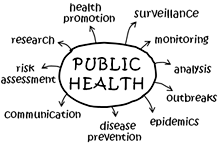 This 3 credit course is designed for MScPH students and will provide a
foundation in the methods and concepts used in public health practice and
research. Students should already understand the concept of population
health, be able to describe major population health determinants and
outcomes, and be able to perform basic epidemiological analyses. The
course will review the structure of public health and will discuss the
legal and ethical basis for public health systems and interventions.
Methods related to public health investigations (e.g., outbreak
investigation, surveillance, risk assessment) will be covered. The
principles and methods of public health interventions will also be
considered (e.g., health promotion, health policy, outreach methods, and
advocacy). Health care systems and financing will be introduced; the
Canadian context will be highlighted drawing on global comparisons.
This 3 credit course is designed for MScPH students and will provide a
foundation in the methods and concepts used in public health practice and
research. Students should already understand the concept of population
health, be able to describe major population health determinants and
outcomes, and be able to perform basic epidemiological analyses. The
course will review the structure of public health and will discuss the
legal and ethical basis for public health systems and interventions.
Methods related to public health investigations (e.g., outbreak
investigation, surveillance, risk assessment) will be covered. The
principles and methods of public health interventions will also be
considered (e.g., health promotion, health policy, outreach methods, and
advocacy). Health care systems and financing will be introduced; the
Canadian context will be highlighted drawing on global comparisons.
Class schedule and other course-related materials for students can be found on course wiki.
EPIB 647 - Computational Analysis of Temporal and Spatial Health Data
Not offered in 2012/2013
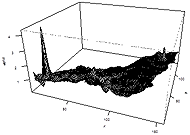 This course introduces substantive material related to the computational
management and analysis of temporal and spatial data sets in epidemiology
with a focus on large data sets found within administrative and clinical
databases. The substantive component is taught mainly through seminar,
focussing on statistical methods for temporal and spatial analysis, and
sound data storage and retrieval practices. The skills component is taught
mainly in the computer lab with exercises integrated tightly with the
substantive areas. In this course, we will not delve into statistical
methods in great depth (e.g., students will not be required to derive or
prove statistics) and we will not attempt to review exhaustively all
statistics applicable to temporal and spatial analysis. Instead, we will
focus on identifying appropriate statistics for a given data set and
research question, preparing the data for analysis, applying statistics,
and interpreting the results.
This course introduces substantive material related to the computational
management and analysis of temporal and spatial data sets in epidemiology
with a focus on large data sets found within administrative and clinical
databases. The substantive component is taught mainly through seminar,
focussing on statistical methods for temporal and spatial analysis, and
sound data storage and retrieval practices. The skills component is taught
mainly in the computer lab with exercises integrated tightly with the
substantive areas. In this course, we will not delve into statistical
methods in great depth (e.g., students will not be required to derive or
prove statistics) and we will not attempt to review exhaustively all
statistics applicable to temporal and spatial analysis. Instead, we will
focus on identifying appropriate statistics for a given data set and
research question, preparing the data for analysis, applying statistics,
and interpreting the results.
